The ‘Thripitkaya’ is a library of Buddhist sacred scriptures
where all the Buddha’s and his disciples’ sermons are contained.
The meaning of word Thripitakaya is “The Three Parts”.
What are those Three Parts?
They are the,
1. Suthras (Buddha’s and his disciples’ sermons at Buddha’s time)
2. Vinaya (the rules and precepts for fully ordained monks and nuns of
Buddha’s disciples)
3. Abhidharma (the deep explanation of Buddha’s teaching)
The section contained suthras has been divided into five sections,
called ‘Nika~ya’.
1.‘Digha’ Nika~ya contained, thirty-four Suthras,
2.‘Majjhima’ Nika~ya contained, one hundred and fifty-two Suthras,
3.‘Sangyuththa’ Nika~ya contained, seven thousand seven hundred and
sixty- two Suthras,
4.‘Angguththara’ Nika~ya contained, nine thousand five hundred and
fifty-seven Sutras,
5.‘Khuddaka’ Nika~ya contained,
Khuddaka Pa~tah, Dhamma Pada, Uda~na Pa~li, Ithi Vuththaka,
Suththa Nipa~ta, Vima~na Waththuh, Petha Vaththuh, Thehra Ga~tha,
Theri Ga~tha, Jathaka, Niddesa, Patisambhida~maggappakaranaya,
Apada~na, Buddhavangsa, Fifteen of Charya Pitakas, Vinaya Pitaka, The
Abhidharma Pitaka, and all the other words of the Buddha.
Why it is called eighty four thousand of Dharmaskanda
(the elements of Dharma)?
“Dwa~si~thing Buddhatho Ganhing
“I bear eighty-four thousand Dhamma elements, including eighty-two thousand elements of the Buddha’s sermons and two thousand elements of the disciples’ sermons”.
Dwesahassa~ni Bhikkhutho
Chathura~si~thi Sahassa~ni
Ye Me Dhamma~ Pawaththino”
In the verse, Ven Ananda Sthavira says this.
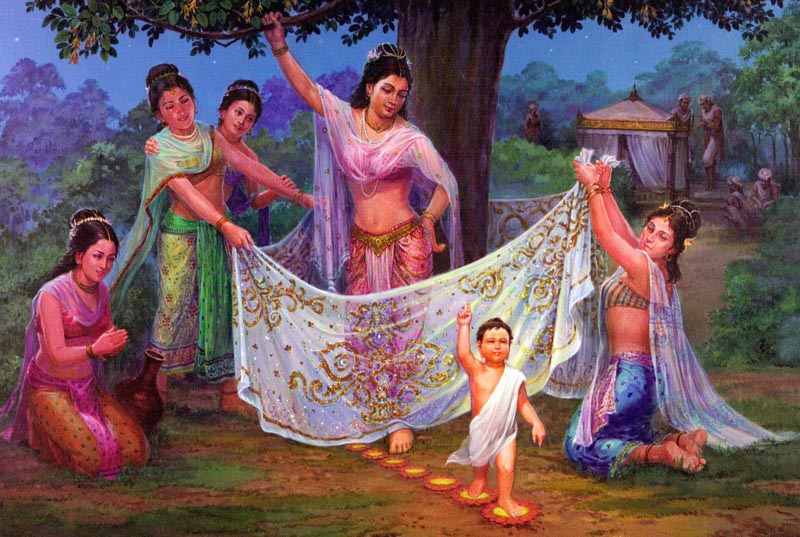
The first Dhamma word of the Blessed One
“Aneka Ja~thi Sangsa~rang Sandha~vissang Anibbisang
Gaha Ka~rakang Gavesantho Dukkha~ Ja~thi Punappunang
Ghaka~raka Dittoh’si Puna Gehang Na Ka~hasi
Sabba~ The Pha~suka~ Bhagga~ Ghaku~tang Visangkhathang
Visangkha~ragathang Chiththang Thanha~nang Khayamajjhaga~”thi.
Ayang Thathah~gathassa Patahma Wa~cha~.
As I walked through the ‘Sansara’ (birth-death cycle) whilst experiencing various types of births, I sought to eliminate suffering by finding the torturer.
Now I saw the torturer.
I will never again grasp anything as “I.”
I neutralised my mind by removing the reason for ‘Craving’, which resulted in the seizing of ‘Craving-Obstinacy-Arrogance’ created by the false notion ‘I’.
is the first word of the Blessed One.

The last Dhamma word of the Blessed One
“Handa Da~ni Bhikkhawe, A~manthaya~mi Vo,
Wayadhamma~ Sangkha~ra~ Appama~dena Sampa~dethah~”thi.
Ayang Thathah~gathassa Pachchihma~ Wa~cha~.
“So, monks, I now urge you to act wisely, being conscious without delay
to eliminate the perception of “I”.
Is the last word of the Tathagata.
From the first dhamma word of Blessed One,
Aneka Ja~thi Sangsa~rang…. to the last Dhamma word, A~manthayami Wo….,
the eighty-two thousand Dhamma elements preached by the Buddha
for forty-five years have the same taste.
That is the taste of liberation.
At any point in that Dhamma, whether at the beginning, middle, or end,
it teaches that One must get rid of the ignorant thoughts of the perception,
‘I – Mine- My eternal soul’.
The teaching is all about how to get rid of that ignorant attachment.
The Buddha has taught the path to liberation from ignorance by cultivating insight through the Four Noble Dwellings (‘Sathara Brahma Viharana’) and comprehending the nature of ‘Anichcha- Dukkha- Anaththa’.
The Four Noble Dwellings (‘Sathra Brahma Viharana’) are
‘Loving Kindness’ (Meththa~), – ‘Compassion’ (Karuna~),
‘Sympathetic Joy’ (Muditha~ ) – ‘Equanimity’ (Upekkha~).
It is the solution to be followed to get rid of the perception of ‘I’ as a permanent person or to achieve liberation by freeing oneself from one’s own mind.
The Dhamma is fulfilled with the three characteristics of ‘Self-deception’ (no actual desire just the craving as I or Mine), ‘Suffering’, ‘Inconstancy’
(Anichcha, Dukkha, Anaththa)
The Dhamma is all about ‘Non-Greed’- ‘Non-Hatred’- ‘Non-Delusion’. (Alobha-Advesha-Amoha).
It has been shown with examples in the Paharada Suthra as follows.
“Paha~ra~da, Maha~samuddo Ekaraso Lonaraso.
“Paharada, no matter where water is taken from in the Great Ocean,
Evamevang Kho Paha~ra~da, Ayang Dhammavinayo Ekaraso, Vimuththiraso.
Yampi Paha~ra~da, Ayang Dhammavinayo Ekaraso, Vimuththiraso”.
it tastes salty.
Similarly, Paharada, this Dhamma, has only one taste.
That is the taste of liberation.
Paharada, as thus this Dhamma, has the one taste,
known as the Taste of Liberation.
Pahara~da Suthraya- Gauthama Buddha
But, is there the nature of such a liberationist doctrine that exists today in Buddhist society?
People seeking liberation should practise the four sublime states of mind.
That is, Buddhists should exhibit loving-kindness, compassion, sympathetic joy, and equanimity.
But does this actually happen?
It is deeply regrettable that, no matter how many times they are explained, it is difficult to impart the correct understanding to these people in today’s society. As such, they are so obstinate in their views.
I believe that the reason these people fail to gain at least worldly cognition is that they do not believe in the consequences of their actions.
Despite their discussions about a terrible ‘Sansara’ they are seen to be entangled in a web of illusions, amassing money and property as well as vices relentlessly.
They believe that they exist as the same human throughout ‘Sansara’ as well and that their country-race-religion-caste-relatives-position-property-price-money remained permanently unchanged in their previous lives and will continue to live the same way even after their death.
Today, thanks to modern technology, we can see and learn about what is going on in the universe:
able to see how the planets and auspicious stars move around the earth where we live,
able to comprehend that, like oneself, planets and stars arise and move incessantly until they cease,
However, it can be seen that these obstinate visionaries believe the planets and stars are in a steady, constant transition, just as he believes himself to be a human forever.
So they act foolishly, holding festivals that represent star transitions according to centuries-old astrology calendars by believing in the beneficial and detrimental effects of the stars.
It is clear from the actions of those ignorant people why the Buddha emphasised that his teaching is only for wise people.
Consider this for a moment.
Assume you walk to work and have been leaving home at the same time and arriving at the office at the same time every day for many years.
Even if you travel the same route at the same time, don’t you think you could be delayed by at least 5 minutes due to a change in weather, an unexpected situation on the side of the road, or your physical fatigue?
In the same way that you and I move incessantly in our ‘Sansara’, the earth, sun, solar system, galaxies with thousands of solar systems, auspicious stars, and all the other stars in the universe move incessantly. All of them have inherited the Inconsistent nature (‘Anaththa’) as well. That is, arises-decays-disappears.
So, do you believe that those planets still transit on the exact dates and times shown in astrology calendars calculated hundreds of thousands of years ago?
We can now see the planets’ transitions between the auspicious stars thanks to computer software developed with modern technology.
Therefore, it is possible to see that the information predicted in ancient astrology calendars is incorrect.
The Earth travels 2.6 million kilometres per day at a speed of 107,226 kilometres per hour whilst it rotates around itself, and the entire solar system travels at a speed of 720,000 kilometres per hour in the galaxy.
Although the solar system travels at such a fast rate, it is estimated that it takes approximately 230 million years to travel around the galaxy.
Meanwhile, scientists estimate that the adjacent galaxies are moving towards each other at a rate of 112 kilometres per second.
As a result, it is clear that the dates predicted hundreds of thousands of years ago for the transits of these planets, which are the objects moving at such speeds, cannot be accurate.
Being entangled in a network of mythic viewpoints that ‘I am the same person who was in the past and I will be the same even after my death’ as a result of ‘Craving- Obstinacy- Arrogance’, these false visionaries grasp the family-property-clan-race-religion-country-position-property-money saying, ‘This is mine- this is for me’, and so on.
In order to protect their graspings, the majority of these mythic visionaries, whether laymen or priests, distort even Buddha’s teachings, sow seeds of hatred and spread greedy-hateful ideas throughout society.
They are so blinded by ignorance that they are oblivious to the consequences of their actions, which will lead them, as well as their followers and listeners, to the four hells.
This person is unaware that the pleasures and rewards he is receiving in this life are the result of good thoughts and actions from previous lives.
This person is unaware that he should continue to do good deeds in this life as his current merits will fade and disappear one day.
This is also explained and highlighted in this book’s Nidhikanda Suthra.
The Buddha had warned in the Sabbasava Suthra about the dangers of becoming a mythic visionary by grasping their own ideology without thinking wisely.
“This my soul, which knows that good and bad will be rewarded according to the good or bad deeds I have done, is eternal and permanent.
I am eternal, like the sun and the moon. Because of my unchanging nature”.
Monks, this is referred to as……
being wrapped by the erroneous view,
getting lost in the erroneous view,
going insane because of the erroneous view,
being shocked by the erroneous view,
being knotted and tangled together with the erroneous view,
being knotted, tangled and wrapped by the erroneous view.
Monks,
The ignorant person who does not hear or see the true nature of many things will not be liberated from ‘Birth-Becoming Sick-Death-Mourning-Lamentation-Pain-Melancholy-Exertion’.
He will not be spared from suffering.
The Buddha stated that he would not teach those who are such false visionaries how to eliminate defilements because they do not engage in the wise contemplation required first to eliminate the fundamental defilements.
This is how the Buddha pointed out the reasons for the disappearance of the Dharma he preached.
| “Dveme Bhikkhawe Dhamma~ Saddhammassa Sammosa~ya Antharadha~na~ya Sangwaththanthi. Kathame Dve? Dunnikkhiththakncha Padabyaknjanang – Aththoh Cha Dunni~tho” “Monks, there are two causes for the Dhamma can be destroyed and vanish. Conveying the misguided or misdirected Dhamma, Misinterpreting or distorting the meaning of Dhamma” |
In 1985, I was fortunate enough to receive the blessing of a venerable thero who had truly taken refuge in the Buddha, Ven Kapuduwe Siri Gunalankara Thero. He even had a great ability to make very accurate predictions. At that time, the signs in front of the shrines of his temple were written, ‘Do not worship gods, do not offer sacrifices, do only share merits’. But then, I did not have the right environment or knowledge to understand it. A few years after his sudden demise in 1986, my youngest brother brought me the novel ‘Araliya Mal Aramaya’ written by Mr Jayasena Jayakodi. The main character of Rahula Thero in that book reminded me of Siri Gunalankara Thero and was also powerful enough to remind me of familiar characters I think I might have met in my past lives. Through that character, I understood that nobles who have cultivated the wisdom of a higher state should be like this, and this is what the Sangha of Buddha’s disciples should be like.
Since then, I have been searching for Buddha’s teaching like a thirst, and I found it in 2015 by reading a book by Venerable Ajahn Sumedho (Ajahn Sumedho Volume 5 – The Wheel of Truth), the main disciple of Venerable Ajahn Cha Thero. During those 30 years, although I had met very few noble Theros, I have only comprehended the Four Noble Truths through reading the book written by Ajahn Sumedo Thero.
Since then, I have cultivated wisdom through Contemplation Meditation (Vidarshana Bhavana).
The understanding I gained during the last seven years and the from many books written by the Nobles who lived between 1875-1950 and the facts contained in the inscriptions written by King Ashoka, it has been confirmed that the teachings of Gautama Buddha have been deliberately distorted.
My readings confirmed that my suspicion that the Buddha’s teaching had been purposefully distorted was correct.
The reason for this could be that Greed-Hatred must be engendered in people in order to sustain the world of lust.
After spiritually comprehending the Buddha’s valuable doctrine, I have tangibly comprehended the Buddha’s doctrine also in the mundane by reading the information discovered about the human body by scientists so far, reports and magazines about scientific discoveries in space, the solar system, the universe, psychology, the human brain, and so on, as well as books written by an American psychiatrist, Brian L Weiss, such as Many Lives, Many Masters, reports of reincarnation by Mr Jim Tucker of the University of Virginia, USA, reports of near-death experiences produced by Dr Bruce Greyson from the University of Virginia in America, the book published in 1922 by the Government of Madras India, about the research done by epigrapher E Hultzsch on the discovery of inscriptions made by King Ashoka, and by watching documentaries about animals created by Mr David Attenborough and many others.
The understanding I gained is the true nature of this world that the Buddha preached in eighty-two thousand components.
I will provide a few examples.
The inconstant nature of the image preached by the Buddha can be seen also in the mundane by observing the formation-disappearance of human body cells.
The cells that make up the human body have a short lifespan.
Usually, 2-3 million red blood cells are produced every second, and they have a short lifespan of approximately 120 days. Some cells in the body have a life span of fewer than ten days. All the other cells in the body also exist in that same way.
Anyone who meditates on it wisely will realise that this body is like a foam that changes, breaks down, and disappears in less than an instant.
Every moment, this body is born, decays, and dies.
This body’s existence will continue as long as the person’s life span, living organs, and cognition remain.
One day, when the perfect merits of human existence deteriorate, the lifespan comes to an end, and the living organ becomes inactive.
In this way, once the perfect merits related to human existence are over, the person’s wealth- relatives- property- education or anything in this world will not be able to give life to that body.
| “A~yu Usma~ Cha Viknkna~nang Yada~ Ka~yang Jahanthimang Apaviddho Thada~ Sethi Niraththahng Va Kalinggarang” “At one day, when the life span, temperature and cognition abandon this body, the body falls onto the ground like a wooden log”. |
The life span of the cells in taste buds in the human tongue is less than ten days.
Is it this tongue that searches for food with taste cravings throughout life, saying ‘I like-dislike’? No, isn’t it?
That is the specially formed mind created by craving, which is maintained throughout the ‘Sansara’ (life and death cycle).
If you watch nature and ecology documentaries about the activities of animals living in the natural environment, you can see how those animals search for food, gather food, the tactics they use to attract the opposite sex, battles among themselves to protect their territories and the tricks they use to find and hide food.
If you examine their behaviour with established consciousness, you may notice that you, as a human, also behave similarly to those animals.
Following that, I would like to speak specifically about the human brain.
Timeless quality is one of the attributes of Buddha’s teaching.
It means that if a human is fortunate enough to hear that dhamma and has the ability to contemplate wisely by establishing his consciousness, he can understand this Dhamma and achieve ‘Nirwana’ regardless of his age or whether the Buddha exists or not.
However, it is essential that one should have an interest in that.
That is, the urge to get rid of the sensual pleasure must come from within oneself.
Modern medical science has now discovered that neurons in the human brain can change size, shape, and efficiency throughout life.
It illustrates that if someone is keen to change, learn, or practise something new, the human brain is capable of doing so.
This is how people like Angulimala, Kasi Bharadwaja, and Alavaka, who had no clear mind or prior knowledge of the Buddha’s teachings, were able to achieve such a noble status.
It should be noted that the brains of mythic visionaries function in the same way.
If they live with delusion, think and act in the same ways, and associate with the same mythic visionaries, the neurons in their brains will continue to function the same way.
They end up destroying their cognitions with ignorance and ending up in the four hells after death by squandering precious human life without taking advantage of the rare human brain they have possessed due to the enormous wealth of perfect merits they accumulated in their previous lives.
Even in the modern developed world, scientists have only discovered a very small amount of information about the solar system we live in, how it moves in the galaxy, and the nature of that galaxy when compared to the information preached by the Buddha in the Chulanika Sutra.
Furthermore, the locations in this world mentioned in some sutras can presumably be found by carefully searching the internet.
Some of the information mentioned in the suthras, such as Chakkawaththi Sihanada, Aggaknya, Atanatiya, and Chulanika, can be confirmed by modern-day customs and rituals.
However, the information we have heard about the kings who ruled Sri Lanka during King Ashoka’s reign in India cannot be found on the internet or in any of the inscriptions that King Ashoka himself had set up all over India.
In addition, King Ashoka was known as ‘Devanam Priya Darshan’, as I learned from inscriptions made by King Ashoka himself.
The inscriptions show that King Ashoka was well-versed in Thripitaka, and we can even see how he highlights the values of some of the suthras in Thripitaka.
In this book, I have translated some of those suthras, including the Muni Sutra, Ariyavansa Sutra, and Moneiya Sutra.
When viewed in this light, it is clear that much of the historical information circulated in our societies is suspicious.
Furthermore, when reading the book written by the Pahian monk in 414 AD, it is easy to understand the social destruction that has been happening to Buddhism since AD 414.
Accordingly, I believe it is inappropriate even to discuss the tragedy that has happened as of today.
Many Buddhist countries have religions called Mahayana, Vajrayana, or other names.
It can be seen that the religion, known as Buddhism in Buddhist Theravada countries, is simply a religion mixed with Jainism and based on cultural activities and rituals such as worship, offerings, and meditations that are performed by only altering the external appearance of the body.
In this way, it is possible to see that the pure teachings of the Buddha have been distorted, and a completely different form of Buddhism is emerging in the present world.
Many lay and monastic Buddhists who claim to be the disciples of Gautama Buddha who taught us to let go of the perception of ‘I-Mine-My soul’ misinterpret and distort the Buddha’s words.
One day, they will be able to realise how much destruction they inflict on themselves because of their unbridled greed when they begin to pay off the repercussions.
Accordingly, this noble teaching has simply devolved into a religion that can be inherited from parents.
This noble teaching has become just another sacrificial object worshipped because of the fear for their lives.
The Buddha and his teachings have devolved into commodities that can be sold for quick money or worn as jewellery to boost one’s image.
In fact, if one believes at least in the repercussions of own deeds, one should protect one’s mind at every passing moment.
Please understand that the Buddha is such an inspiration beyond words.
One should be very careful even when saying the name ‘Buddha’.
 Aaryasathya