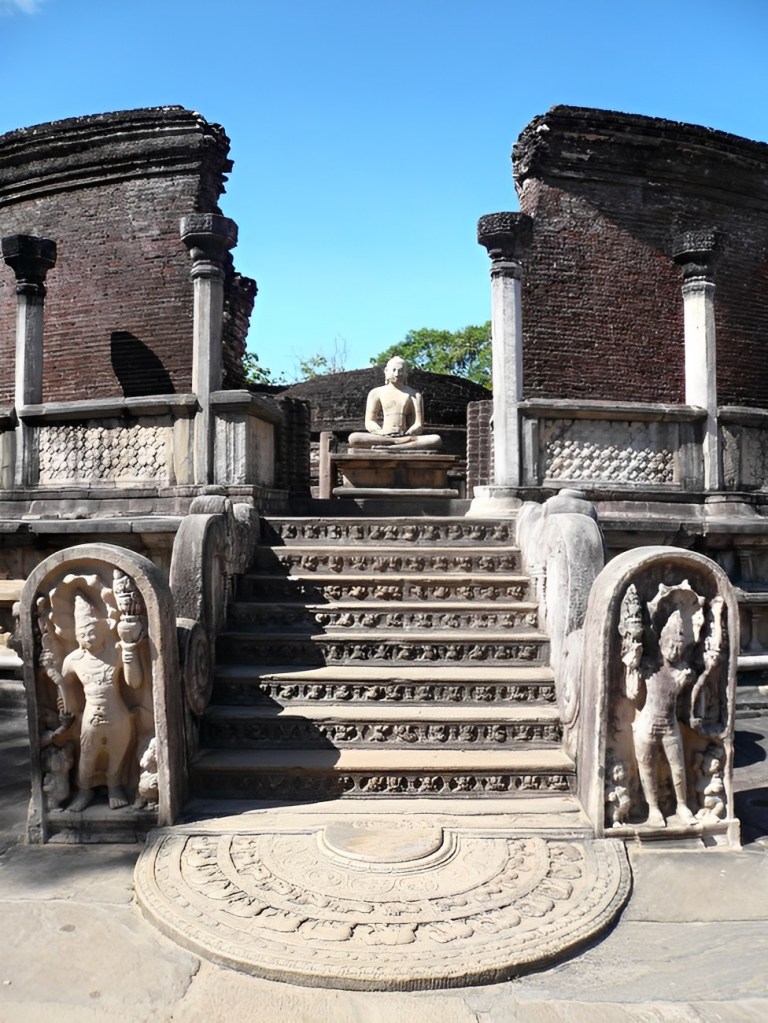
Until today, when you entered a temple and stepped on the Sandakada Pahana (Moon Stone) at the doorstep, have you ever thought about what message the carver has tried to depict?
Before reading this book, it’s necessary to understand the dharma message that the carver has pointed out. This book is intended for those searching for Dharma, seeking refuge in Buddha, and desiring to become a noble disciple.
The first semi-circle part with flames of the Sandakada Pahana indicates the ‘Sansaara’, where all seen and unseen beings have been wandering and burning in the fire of suffering. Placing that Sandakada Pahana at the door of a Buddhist temple shows that you are now walking towards Nirvana, where you can be tranquil and relieved.
The flames represent the real suffering of Jati (birth)-Jara (decay) -Vyadhi (illness) -Marana (death)-Shoka (sorrow)-Parideva (wail) -Dukkha (suffering)-Domanassaya (despair).
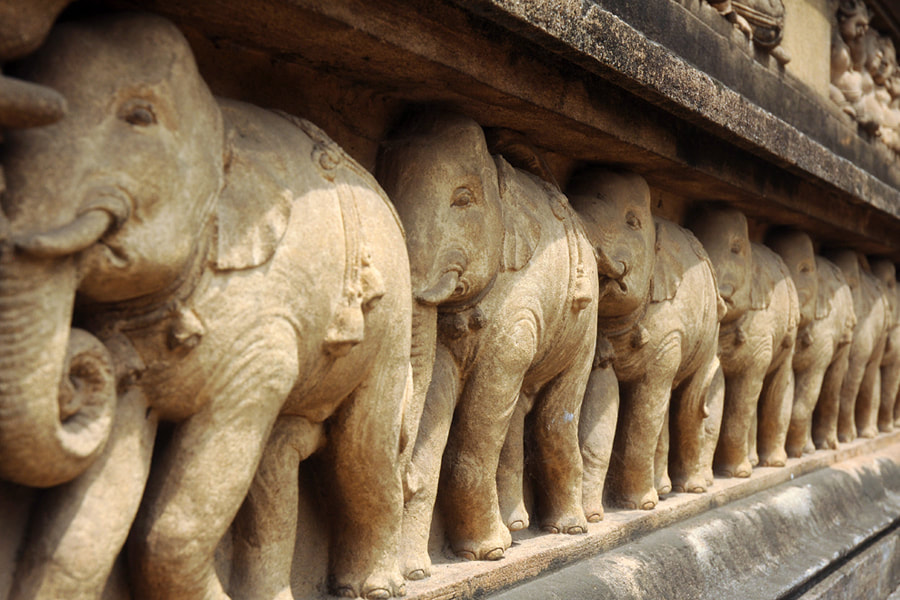
The second curved section with four different animals represents the elephant for intelligence, the horse for a strong mind, the bull for patience and vigour, and the lion for bravery strong enough to conquer lust and follow the transcendental path.
Accordingly, to find and understand the correct doctrine preached by the Buddha, one must know that he must be intelligent, strong in mind, patient, and brave enough to overcome lust and follow the transcendental path.
On the third curved part, there is a complex embroidery art called ‘liya wala’ that portrays a blend of cultural, spiritual, secular, and religious elements as well as Nirvana, which can be found inside a temple or in the person heading towards it. To attain the pure fourfold truth, one must possess the mentioned attributes.
Similarly, while reading this book, you may come across some spelling or grammatical errors. My only intention is to show the Dharma as spoken by the Buddha, and I expect you to read this book with that in mind.
Swans with three paddy spikes in their beaks can be seen in the next curving section. As a swan separates milk from water, the human being with the abovementioned noble qualities discovers the proper Dharma through the complex environment stated above and seeks refuge in Buddha-Dhamma-Sangha.
The next curved part consists of simple embroidery art. This noble individual lives by contemplating and intelligently comprehending the Dharma since he took refuge in the Buddha.
The lotus flower at the end shows that the noble disciple attains “the great Nirvana”.
The noble disciple who attained “the great Nirvana” will never again enter that ‘Sansaara’, like a blossoming lotus born in mud and does not touch the dirt once it blooms.
“Dittincha Anupagamma Si’lava’
-Karaniya Metta Sutra
Dassa nena sampanno
Ka’mesu Vineyya Gedhang na hi ja’thu Gabbhaseyyang Punarethi”
 Aaryasathya